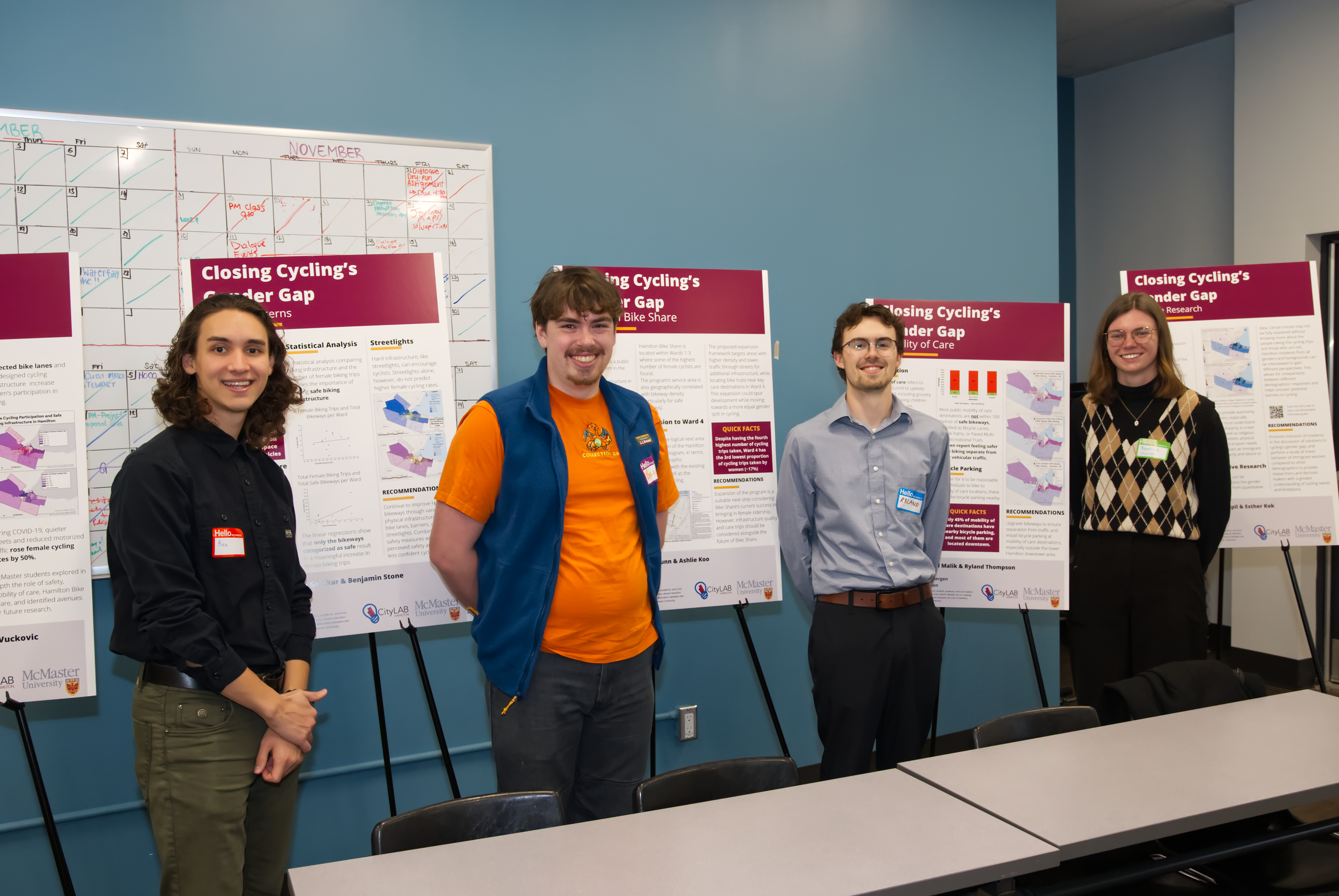
CityLAB Hamilton students tackle community-focused projects that align with municipal priorities, gaining tangible experience along the way. Image credit: CityLAB Hamilton
Post-secondary students in Hamilton, Ontario, are getting a close-up view of the value of municipal operations while building transferable skills as part of CityLAB Hamilton’s experiential learning program. An innovative partnership between the City of Hamilton, Mohawk College, McMaster University, and Redeemer University, CityLAB Hamilton connects students, faculty, and civic leaders with community-focused projects that align with the City’s strategic priorities. Since its inception in 2017, the program has welcomed more than 4,500 students and supported over 260 hands-on projects across the city.
Modelled on similar experiential learning programs elsewhere in Canada, CityLAB Hamilton is distinct because it is housed within the City Manager’s Office, which gives the team a level of insight and access into priorities, projects, and staff across multiple municipal divisions. As a result, the projects are varied and represent the city’s current strategic priorities, giving students meaningful opportunities that address specific local needs. Projects may be suggested by city staff, faculty members, or the community, and have encompassed a wide range of academic disciplines and programs of study. They have included designing public awareness campaigns, conducting policy research, analyzing data, and increasing community engagement. Each year, program participants contribute to dozens of projects as part of their coursework, including independent or group research, hands-on participation outside of the classroom, and research competitions such as the Higher Education Analytics Data competition.
The CityLAB Semester in Residence program takes student involvement a step further. This comprehensive program is a full course load for upper-level undergraduates that trains them in project management, community engagement, and design thinking, with a CityLAB project incorporated into the curriculum. Drawing students from across disciplines, the program offers an immersive environment in which students work directly with municipal staff, community organizations, and subject matter experts to solve complex problems that include a community engagement and dialogue component.
Students leave the program with new skills and connections as well as, most importantly, a sense of the impact local government can have. One multi-year project brought students together with the downtown community and business improvement area (BIA) to create a pedestrian hub on a major downtown road, including permanent art features and a decorative gate that can be lowered to turn the street into space for festivals and art crawls. Another saw students in a graphic arts program contribute to the “Unfiltered Facts” campaign for nicotine harm awareness. Such initiatives are a win-win: students contribute fresh perspectives and energy, gaining tangible experience on real projects while expanding municipal staff capacity and providing a value-added service for the Hamilton community. 
Early support from elected officials helped to get the program started, and a three-year pilot phase with dedicated program staff allowed CityLAB to ramp up and demonstrate success in terms of student engagement, physical infrastructure improvements, and over 100 completed projects. When the COVID-19 pandemic hit at the end of the initial pilot, the program had proven itself enough to justify picking up even more projects as it moved online, supporting core city work as municipal staff were pulled into emergency priorities. Since then, CityLAB has built on its strong relationships – many City staff have participated on multiple projects. Several former student participants have gone on to work for the city, including two members of the city’s Active Transportation and Mobility team who now host CityLAB projects themselves.
By bringing together city staff, post-secondary institutions, and community organizations, CityLAB is encouraging a culture of civic participation, collaboration, and shared problem-solving, which in turn is helping to make Hamilton a more vibrant, healthy, and sustainable city.
-Having the program embedded within the City Manager’s office, with dedicated classroom space in a municipal building and an ongoing funding commitment from city council, allows for long-term planning and increases engagement from partners. Municipal oversight also allows the program team easier access to City staff and to a view of the work underway across the whole organization – and across the physical city itself. -The program has a strong two-layer governance model, with ongoing representation from each educational institution and the City on both a steering committee (which demonstrates commitment and ensures alignment with municipal and institutional priorities), and a program committee (which ensures good matches of projects, faculty, and students). -A project showcase at the end of each term allows students to celebrate their impact in a series of infographics and flash presentations for an audience of City staff and community members. This event has in turn inspired and attracted new participants and projects, building momentum from year to year.