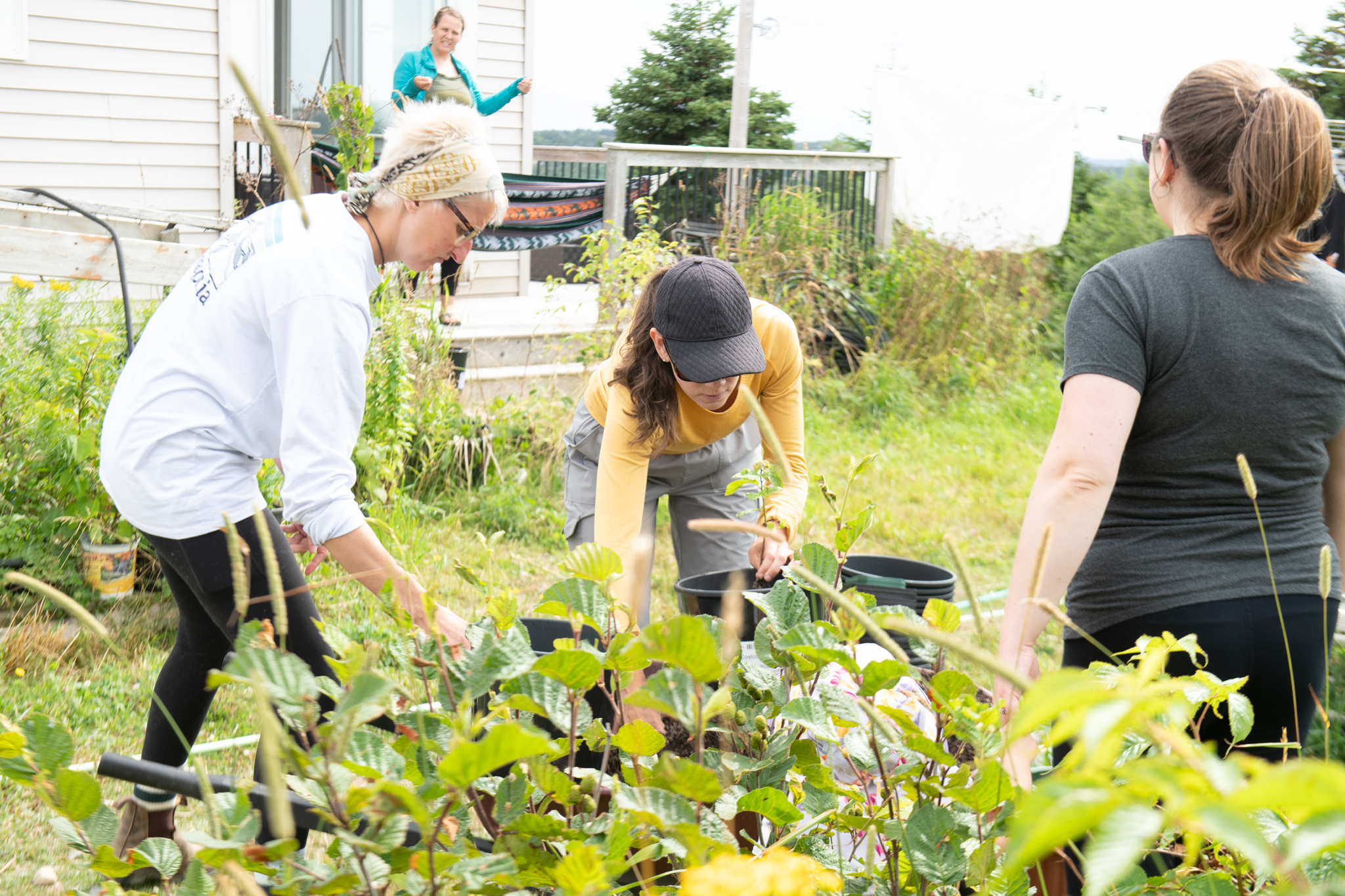
Working on the community farm at Killick Ecovillage in Portugal Cove-St. Phillip’s, N.L. Image credit: Killick Ecovillage
The Killick Ecovillage Co-operative in Portugal Cove-St. Phillip’s, N.L., is a cohousing village that has worked to address many of the challenges that smaller communities face when creating a Community-Led Housing (CLH) project, beginning with obtaining the necessary knowledge base, resources, and funding. Once built, the village will be a 51-home sustainable, multi-generational, mixed-income community. The project began with a group of individuals with a vision who pooled resources to buy a 58-acre heritage farm and are planning to build a 9-acre housing development.
Most public funding streams for CLHs are geared toward larger projects, and so were not a fit for Killick. Instead, the founders combined resident investment, grants, and external financing to build a shared foundation for the project. Resident investment in the village makes the project unique among CLH models available in Canada. While traditional models such as co-ops and CLTs provide residents with decision-making power in the development of their community, the residents are still leasing the land from a larger organization that manages ownership. Members of the Killick Ecovillage, in contrast, will have long-term leases on their own homes, with the autonomy akin to home ownership, as part of Canada’s first Mutual Home Ownership Society (MHOS).
Based on a successful framework imported from the United Kingdom, a MHOS is a CLH model in which residents collectively own their properties – an approach that disconnects occupation of the property from its land value, protecting the houses from losing affordability with market fluctuations. At the Killick Ecovillage, the community carries a single mortgage. Each household contributes a resident share with a minimum loan component of $15,000 and pays an all-in-one community fee that is capped at 35% of household net income. Because contributions are scaled to income, higher-income residents help subsidize housing costs, making it more affordable for others. At the same time, there is a cap on the loan amount, creating an incentive for higher earners to pay off their loans quickly once they reach the limit, after which they can earn interest on their balances. Residents can choose from homes at different price points, with less expensive homes resulting in smaller loans and faster payoffs.
At Killick, the governance model is intended to foster continued community engagement. From its inception, the resident community was shaped through a participatory design process, with workshops that invited brainstorming and discussion about the members’ ideal future together. Today, residents continue to guide the evolution of the co-op through consensus-based decision-making. They collectively identify needs and assign people to take on internal roles, such as waste management, food production, or maintenance; where additional expertise is required, they decide as a group whether to hire external support, often pursuing grants to offset costs. This shared governance framework sustains community decision-making while ensuring that operations, services, and long-term plans remain aligned with the community’s values and needs.

A community vision workshop is part of Killick’s participatory design process. Image credit: Killick Ecovillage