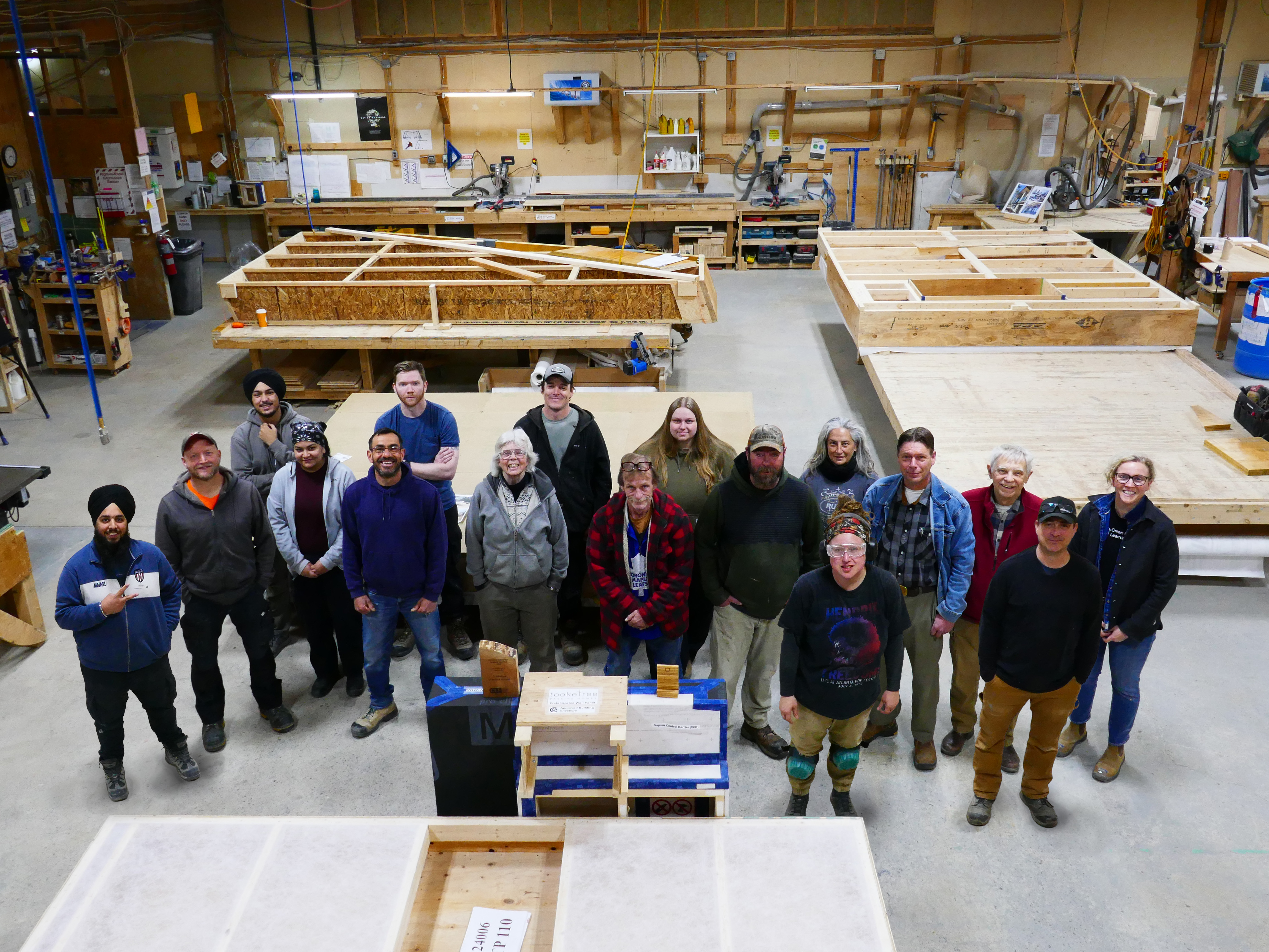
The Tooketree team produces sustainable building panels in its Baysville factory. Image credit: Tooketree Passive Homes
Construction is a major driver of greenhouse gas emissions (39% globally), with cement production alone accounting for about 8% of global carbon dioxide output. The construction industry also faces deep labour challenges: many workers encounter mental health and safety risks, while women and other underrepresented groups remain largely excluded from leadership positions in the trades. Tooketree Passive Homes, a modular housing developer based in Muskoka, Ontario, was founded in 2018 to address both of these issues, as well as the high cost of housing. Its multifaceted approach produces affordable, energy-efficient housing while diversifying the workforce and improving labour conditions – a mission recently recognized with Tooketree’s certification as a social enterprise.
Central to the Tooketree model is the development of sustainable, ecological, efficient, and durable (SEED) panels, which sequester carbon and insulate the building so that it uses 90% less energy to heat and cool than a conventional home. Adapted from European prefabrication methods, the panels use local, renewable materials such as wood and recycled cellulose. The standardized design allows Tooketree to guarantee fixed pricing and deliver homes with higher energy performance than typical site-built construction, where efficiency features are often cut to save time and money.
Tooketree collaborates with partners such as the Federal Economic Development Agency for Northern Ontario, Natural Resources Canada, Keepers of the Circle, Passive Design Solutions, and Builders for Climate Action to validate and expand its work. Its partnership with Keepers of the Circle, an Indigenous women’s organization in Kirkland Lake, highlights how collaboration drives Tooketree’s mission: women take on leadership roles and receive training while contributing to the region’s manufacturing capacity. This approach reflects Tooketree’s long-term vision of locally owned factories that share expertise while remaining independent, creating resilience in a sector vulnerable to economic fluctuations.
To date, Tooketree has sequestered 105,000 kg of carbon through SEED panels, created nearly 56,000 hours of living-wage employment, and delivered 65 housing units. Since 2022, it has provided nearly 5,000 hours of on-site training to Indigenous women and employed more than 30 women in trades. In 2024, Tooketree’s leadership was recognized with the Innovation in Industry Award from the Ontario Embodied Carbon Awards. Looking ahead, Tooketree aims to expand capacity by up to tenfold – from 100 to 1,000 units annually – and retrofit existing buildings with SEED panels.
Tooketree’s vision extends beyond producing housing units: it is helping to reshape the construction industry into one that has a lower carbon footprint, is more inclusive, and prioritizes collaboration. By proving that sustainable, affordable housing can also strengthen local economies and diversify the labour force, Tooketree demonstrates that tackling the housing crisis and the climate crisis can – and must – be pursued together. Its model shows how innovation, collaboration, and equity can converge to deliver long-term solutions, offering a blueprint for communities across Canada.